Three Years After ChatGPT: From chatbots to agents and other trends on the frontier of generative AI

2nd December 2025

17:00-19:30 UTC

Click here to Register

Three years after the public launch of ChatGPT, the chatbot paradigm has undergone a transformation. The main mode of interacting with Large Language Models is no longer just a chat.

In this session, Dominik Lukeš will step back from day-to-day changes to look at how the landscape has shifted since 2022 and what the current frontier in what “AI can do” and what “we can do with AI” looks like. But even more importantly, what does 2025 look like that we did not imagine as recently as 2024.

The session will cover:

  • Frontier vs history: How today’s leading models differ from the first wave (capabilities, reliability, cost, deployment patterns) and what has stayed surprisingly constant.
  • New model ecosystem: The landscape of new frontier models and their capabilities, reasoning, agentic capabilities and the rise of open models.
  • Transcending the single chat: From models outputting text to models using tools, working in loops as agents and orchestrating complex workflows.
  • Beyond chat interfaces: From reading text in a chat to LLM-generated interfaces and vibe coded tools to explore meanings. 
  • Multimodality: How we’ve “solved” speech and video recognition and generation.
  • Platforms and industry structure: Who are the key players now, who is on the rise and who has fallen away?
  • Implications for academic practice and knowledge: What this means for how we do research and learn about the knowledge it generates.

Inaugural Meeting

The AI Thought Exchange was officially launched on Friday 21st June in a meeting that discussed the past, present and possible future of AI in higher education. Chaired by Dr Isabel Fischer, three presentations led to a discussion of implications for HEIs in a range of countries. Our thanks to Dominik Lukeš, Dr. René Moolenaar, and Dr Isabel Fischer, for these presentations.

First reviewing the rapid development of AI, there are clear indications that a major upheaval in assessment is imminent, posing complex challenges for higher education institutions. Please click to view this presentation

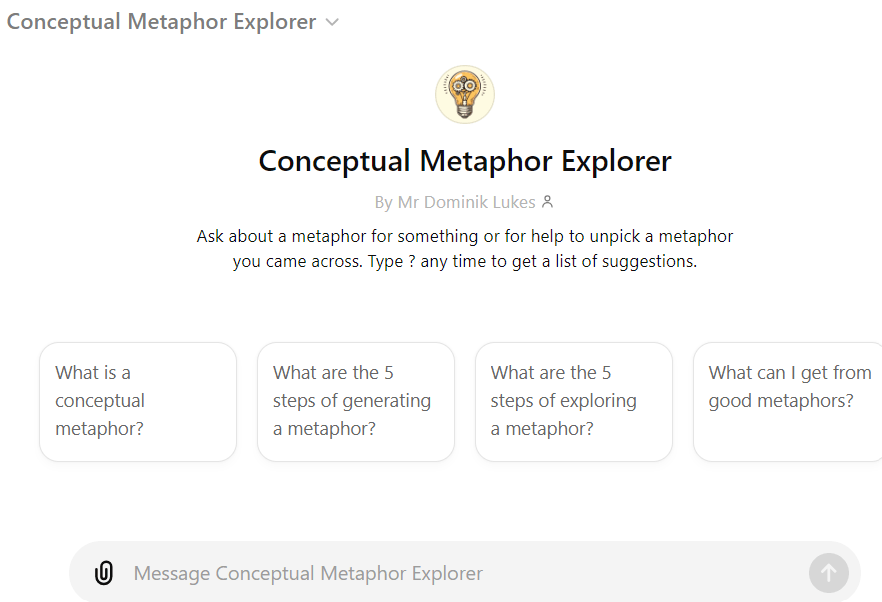
Taking the specific example of formative feedback, our presenters shared their experiences to date using newly published APIs to built custom chatbots to answer student queries, and even review claims or plans. This implementation of Chat-GPT specifically focuses on conceptual metaphors.

A screenshot of a AI LLM bot to discuss conceptual metaphors

It is also possible to train GPT LLMs on your own content. To demonstrate, Dominik has published his entire slide deck on AI dating back to 2019, and links to a GPT interface which allows users to ‘chat’ with this content.

Secondly, Dr. René Moolenaar shared his experience of building a bespoke student focussed GPT (in ChatGPT 4): entitled ‘René’s Marketing Companion’. Designed as an additional source of help/guidance for students, to complement existing sources of help and was trained on his own slides with no use of internet sources.

In our third discussion point, Dr. Isabel Fisher shared her experience of using non-GPT AI tools to provide formative feedback tool (non-GPT AI).

Other resources shared include:

Credits: feature photo by Jesse Gardner on Unsplash