Three Years After ChatGPT: From chatbots to agents and other trends on the frontier of generative AI

2nd December 2025

17:00-19:30 UTC

Click here to Register

Three years after the public launch of ChatGPT, the chatbot paradigm has undergone a transformation. The main mode of interacting with Large Language Models is no longer just a chat.

In this session, Dominik Lukeš will step back from day-to-day changes to look at how the landscape has shifted since 2022 and what the current frontier in what “AI can do” and what “we can do with AI” looks like. But even more importantly, what does 2025 look like that we did not imagine as recently as 2024.

The session will cover:

  • Frontier vs history: How today’s leading models differ from the first wave (capabilities, reliability, cost, deployment patterns) and what has stayed surprisingly constant.
  • New model ecosystem: The landscape of new frontier models and their capabilities, reasoning, agentic capabilities and the rise of open models.
  • Transcending the single chat: From models outputting text to models using tools, working in loops as agents and orchestrating complex workflows.
  • Beyond chat interfaces: From reading text in a chat to LLM-generated interfaces and vibe coded tools to explore meanings. 
  • Multimodality: How we’ve “solved” speech and video recognition and generation.
  • Platforms and industry structure: Who are the key players now, who is on the rise and who has fallen away?
  • Implications for academic practice and knowledge: What this means for how we do research and learn about the knowledge it generates.

The Future of Assessment

The AI Thought Exchange welcomes you to a discussion on the Future of Assessment.

10th June 2025 – Online

Agenda (Times indicated are UK times):

8.30am Welcome (Isabel Fischer) and introductions & networking (name and institution)
8.40am Horizon Scanning AI and their application to HE, thoughts on current trends

8.45am Provocation 1: The purpose of assessments (Vaughan Connolly)

9.00am Provocation 2: The Future of Assessments (Simon Walker)

9.15am Discussion (if time, including a discussion on how to manage emotions to get stakeholders to agree to a change of assessments and marking & feedback provision of assessments).

9.45am Next steps, and topic(s) for next meeting.

Deep Dive

On the 18th March, AITE founding member Dominik Lukeš reviewed the latest updates and trends in AI. In his rapid and hugely engaging review, he introduced eight trends that he believes will be the most consequential for future academic practice. In each case he deftly illustrated his talk with examples of AI in action, demonstrating the dazzling and surprising pace of development, and its myriad applications in the HE sector.

  1. Multimodality: In just two years, we’ve moved on from models that can have a text chat, to models with which we can have a voice conversation and which can understand images. We started with technology that could convert text to speech, and now we can convert text into a full podcast using our own voice in almost any language, accent and with a personality. It is hard to underestimate how consequential this is.
  2. Interfaces and user experience: ChatGPT started with an interface innovation – chat. But since then, the range of interactions within the chat and also completely outside of chat has completely transformed. OpenAI introduced Advanced Data Analysis and Canvas, Anthropic created Artifacts in Claude, Elicit have introduced Notebooks, Google created NotebookLM, Perplexity and others offer a desktop app, Cursor have transformed coding. Each of these innovations is showing us that we are moving far beyond chat but also beyond what we were used to software is like.
  3. Long context windows: When ChatGPT was released, users could paste in a long newspaper article. By the end of the summer 2023, the users of Anthropic’s Claude could ask it questions about a short novel thanks to its model’s context window of 100,000 tokens. However, in January 2024 Google announced that its Gemini model would have One Million context window with more to come. This means that the model could “see” several dozen academic papers or a life time worth of notes at once. As context windows continue to get larger, the scope of what Large Language Models can do will increase in unpredictable ways but it is sure to transform academic practice radically.
  4. Small local language models: When ChatGPT was released it ran on a model with 175 billion parameters and it is estimated that the latest frontier models have 500 billion or more. This was thought to spell doom for Open Source and the idea of AI running on a user’s own computer. But at the same, new techniques started appearing for making models smaller and more efficient. This effort was spurred by Meta releasing an Open Source model called Llama in the spring of 2023. Since then, capable small models (with 1 – 8 billion parameters) have become commonplace and both Microsoft and Apple have released on device models built into their operating systems. Small local language models will never fully replace the best LLMs but they will open up a range of possibilities that we can now start seeing the shape of.
  5. Reasoning models: Introduced into the world only in September of 2023 with OpenAI’s release of the o1 model series, reasoning models have become a key trend in the development of Large Language Models that overcome many of the problems faced by models. In particular, they can solve more complex problems that require more deliberation. Reasoning models build on the popular Chain of Thought technique where models are known to produce better results in some areas when they output the whole process for deriving the solution before giving the final answer. Reasoning models were fine-tuned to output much longer chains of thought in the background before giving their answer. Reasoning models do not replace or even outperform “traditional” LLMs in all areas but they are ideal for complex programming and other STEM related tasks. They are a key driver in the recent progress of models on complex tasks and since the release of o1 preview, OpenAI have now released full o1 and announced the o3 series to be released. Google have also released a reasoning model and there are also 2 Open Source reasoning models QwQ from Qwen and R1 from DeepSeek.
  6. Agents: Agents are the most speculative and exciting development in generative AI. Up until now, most of the things people do with AI are those that can be achieved with a series of prompts in a chat session. Over the last year, many new techniques have appeared for extending what Large Language Models can do by creating “agent systems” where the model not only responds with the outline of a plan of action but can also start new threads performing the actions from the plan. This could mean writing a complete software application or translating a whole book. So far, we are only seeing glimpses of potential and it is not clear what the limits are but there is no doubt that this will be the most significant trend for the year to come.
  7. Evaluation Crisis: The difficulty of creating meaningful and lasting benchmarks.
  8. Contradictory Cost Dynamics

For a longer version of this summary, please see Dominik’s website.

Future Thinking

The AI Thought Exchange is pleased to invite you to a discussion on Future Thinking.

Tuesday 29 April 2025

Times indicated are UK times: 

8.30am Welcome (Isabel Fischer) and introductions & networking (name and institution)
8.40am Horizon Scanning AI and their application to HE, thoughts on current trends
8.50am Provocation 1: How can we combine knowledge generation and future thinking at a time of rapid technology changes? (Bennie Anderson)
9.00am Discussion
9.20am Provocation 2: How can futuring be used in the classroom to support AI literacy and how can GenAI – that is built on past information – support futuring work? (Jennie Mills)
9.30am Discussion
9.50am Next steps, and topic(s) for next meeting. Suggestion: Should / how can we use AI in the summative feedback and marking provision?

Please sign up here to register your interest.

A ‘deep dive’ on the current State of AI

The AI Thought Exchange is pleased to invite you to:

A ‘deep dive’ on the current State of AI: What are the biggest recent developments and trends in generative AI

18th March 2025

08:30 to 10:00 am UTC

It has only been a little over two years since ChatGPT came on the scene but the landscape of generative AI tools and their capabilities has changed completely. In particularly, there have been many shifts in the last 4 months that have set the agenda for development and what we need to pay attention to. This session will cover these developments and examine what they mean for the future of AI and education. In particular, we will look at advances in model capability, multimodality, rise of local models, reasoning models, agents and the usability of interfacing with the power of the models. At the same time, many of the limitations Large Language Models started with are still with us and this session will highlight these as well. 

Hosted by Dominik Lukeš, Lead Business Technologist for AI and ML Competency Centre, University of Oxford.

Please sign up here to register your interest.

General Meeting Agenda 11th February 2025

Times indicated are UK times: 

8.30am Welcome (Isabel Fischer) and introductions & networking (name and institution)

8.40am Horizon Scanning AI and their application to HE

8.45am Highlights from the February Sydney conference

8.50am Thoughts on current trends

9.00am Provocation 1: How can AI ever be fair in an unequal world? (Max Morel)

9.10am Discussion

9.30 am Provocation 2: Writing & speaking skills: Expectation gap too large to fill for EAL speakers? (Margarita Nuñez Canal)

9.40am Discussion

9.50am Next steps, formalities & resources (Ann Kristin Glenster, Glenlead).

Finally, please note there will be an additional February meeting: ‘Deep Dive on Technology Trends and their potential application to education’ (Dominik Lukes).

As ChatGPT turns two, join Dominik Lukeš as he discusses The State and Future Directions of generative AI

  • Thu, Nov 28
  • 4:00 PM – 5:30 PM GMT
  • Online
  • Register 

ChatGPT has ushered in a technological but also societal revolution. On the two-year anniversary of the release of ChatGPT, join AITE founding member Dominik Lukes as he reflects on the journey to today and the current state of generative AI with a focus on what has changed compared to our expectations in 2022, what has stayed the same and what we can see coming on the horizon.

What his webinar will cover

Dominik’s webinar will try to answer the question: ‘Now that we’ve had ChatGPT and other tools for two years, what do we know and what should we expect in the future.’ In particular, it will try to answer these questions:

  1. What was it that was so transformational about ChatGPT?
  2. What were the key technological breakthroughs that enabled the Large Language Models to become widely useful?
  3. What has changed about the capabilities of Large Language Models in the intervening too years?
  4. What are the cutting edge developments that promise future improvements.
  5. What does the application landscape look like with two years worth of investment?
  6. What do we know about the wider impact on society and in particular higher education?

Specifically the webinar will explore about these technical developments:

  • Opportunities arising from full multimodality
  • Consequences of large context windows
  • Agents and other promising developments in AI engineering
  • Smaller language models and on-device use

Two Years After ChatGPT: Reflections on The State and Future Directions of generative AI

For related resources and thought, please see Dominik’s blog on Five Trends in generative AI and their impact on academic practice

27 November 2024 – AI Thought Exchange Agenda

Please see below the agenda for the next meeting of the AI Thought Exchange (AITE) on 27 November 2024. 

Times indicated are UK times: 

  • 8.30am Welcome (Isabel Fischer) and introductions / networking (name and institution)
  • 8.40am The Promise and the Peril of AI in the Workplace (Nik Nicholas, Covelent)
  • 8.50am Future skills needed in an AI-enabled workplace (Matt Lucas, IBM)
  • 9am Discussion and Q&A on the preparation of students for AI in the workplace
  • 9.15am Pedagogic contribution: Is Bloom’s taxonomy still relevant? (Colin Fu, UCL)
  • 9.25 am Subject to time – Discussion Question: Is native speakerism enforced through GenAI, i.e. will there be in the future less tolerance for deviation from ‘eloquence’ and thus less space for authenticity and students bringing in their own voice without the help of GenAI? (Isabel Fischer, Warwick)
  • 9.30am 2nd round of discussion / AI thought exchanges
  • 9.45am Topic suggestions for the next meeting (14/2/2025)
  • 9.50am next steps, formalities & resources (Ann Kristin Glenster, Glenlead).

List of References / ‘Optional’ advance material for Nik Nicholas / Covelent’s contribution:

Finally, as the purpose of the meeting is to exchange thoughts, do come in person rather than sending your AI bots.

Inaugural Meeting

The AI Thought Exchange was officially launched on Friday 21st June in a meeting that discussed the past, present and possible future of AI in higher education. Chaired by Dr Isabel Fischer, three presentations led to a discussion of implications for HEIs in a range of countries. Our thanks to Dominik Lukeš, Dr. René Moolenaar, and Dr Isabel Fischer, for these presentations.

First reviewing the rapid development of AI, there are clear indications that a major upheaval in assessment is imminent, posing complex challenges for higher education institutions. Please click to view this presentation

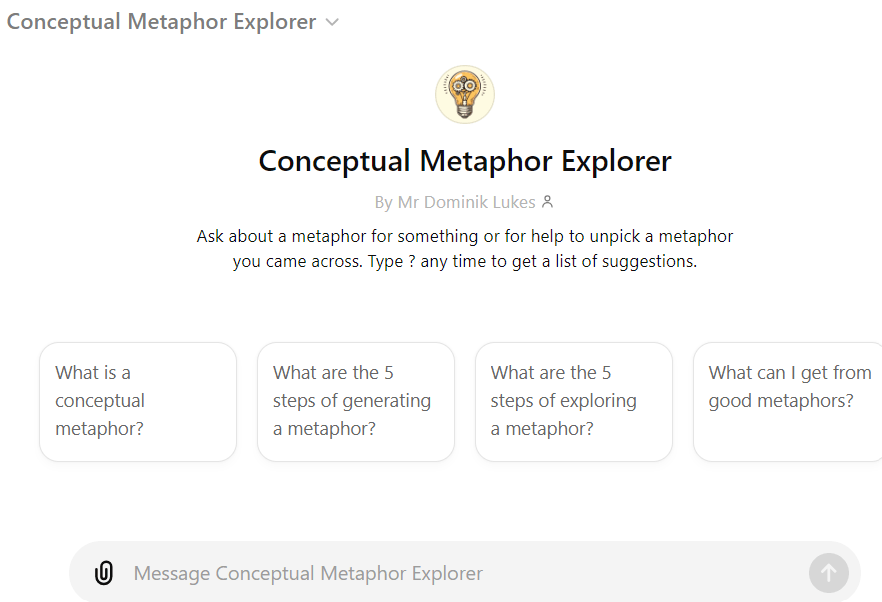
Taking the specific example of formative feedback, our presenters shared their experiences to date using newly published APIs to built custom chatbots to answer student queries, and even review claims or plans. This implementation of Chat-GPT specifically focuses on conceptual metaphors.

A screenshot of a AI LLM bot to discuss conceptual metaphors

It is also possible to train GPT LLMs on your own content. To demonstrate, Dominik has published his entire slide deck on AI dating back to 2019, and links to a GPT interface which allows users to ‘chat’ with this content.

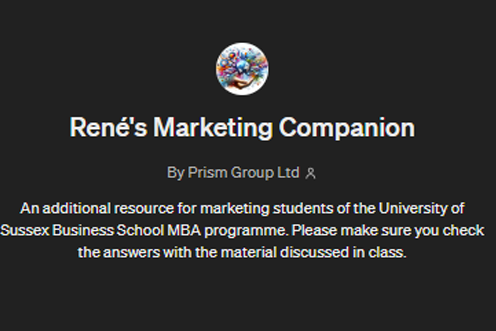
Secondly, Dr. René Moolenaar shared his experience of building a bespoke student focussed GPT (in ChatGPT 4): entitled ‘René’s Marketing Companion’. Designed as an additional source of help/guidance for students, to complement existing sources of help and was trained on his own slides with no use of internet sources.

In our third discussion point, Dr. Isabel Fisher shared her experience of using non-GPT AI tools to provide formative feedback tool (non-GPT AI).

Other resources shared include:

Credits: feature photo by Jesse Gardner on Unsplash